A Poet that Inspired Me

Carl Sandburg writes free verse with a creative twist defining modern poetry styles as “ear wigglings”.  I love writing free verse because I can rhyme or not, I can repeat lines at will because there are no boundaries to define me.”Poetry is the opening and closing of a door, leaving those who look through to guess about what is seen during a moment.”~Sandburg What I love is how his poems continue to attract new audiences every day.

Mask

Fling your red scarf faster and faster, dancer.
It is summer and the sun loves a million green leaves,
masses of green.
Your red scarf flashes across them calling and a-calling.
The silk and flare of it is a great soprano leading a
chorus
Carried along in a rouse of voices reaching for the heart
of the world.
Your toes are singing to meet the song of your arms:

Let the red scarf go swifter.
Summer and the sun command you.

Fog By Carl Sandburg

The fog comes
on little cat feet.

It sits looking
over harbor and city
on silent haunches
and then moves on.

“Richard Crowder notes in Carl Sandburg, the poet ‘Had been the first poet of modern times actually to use the language of the people as his almost total means of expression…. Sandburg had entered into the language of the people; he was not looking at it as a scientific phenomenon or a curiosity…. He was at home with it’.”

“Sandburg, Pulitzer Prize–winning poet and biographer of the quite sensible Abraham Lincoln, remains one of the great unrecognized writers of nonsense. Rootabaga Stories, Sandburg’s widely read but critically ignored collection of abstruse stories, is most often—but maybe dismissively—considered children’s lit. Sandburg, on the other hand, considered his so-called Rootabaga country for readers “5 to 105 years of age.”

“The Rootabaga stories were,” Sandburg wrote, “. . . attempts to catch fantasy, accents, pulses, eye flashes, inconceivably rapid and perfect gestures, sudden pantomimic moments, drawls and drolleries, gazings and musings—authoritative poetic instants—knowing that if the whir of them were caught quickly and simply enough in words, the result would be a child lore interesting to child and grown-up.”

Nonsense has come to connote a style of nursery rhymes, little comic vignettes, or limerick-y sketches; it is not primarily a genre but a device. It functions in two primary ways: by defying logic with paradox and confusion (“the red brick is blue”) or with semantics, ignoring fundamental grammar rules such as subject-object relationship. Sandburg’s stories fall into the former category—they explore anti-logic rather than anti-grammar. Sentences look like sentences, but they read like something else altogether.”

Sources:

https://www.poetryfoundation.org/poems-and-poets/poets/detail/carl-sandburg

https://www.poetryfoundation.org/features/articles/detail/69463

Women’s History Month

This month is women’s history month!  Who are some of your favorite female authors?

Mine are in no particular order just as they popped into my head:

Eleanor Roosevelt, Virgina Woolf, Kate Chopin, Maya Angelou, Natalie Goldberg, Anne Lindberg,

Jane Austin, Mary Shelley. Louisa Alcott, Sylvia Plath, Anne Sexton,  Pema Chodron,

Rachel Corson, Wilma Mankiller, Toni Morrison, Charlotte Bronte, George Eliot,

Alice Walker, Emily Bronte, Emily Dickinson, Ursula K Le Guin, Margaret Mitchell, Edith

Wharton, Willa Cather, Judy Blume, Mary Wollstonecraft, Anne Frank, Malala

Yousafzaifzai, Susan Sontag, Margaret Sanger, and Shirley Jackson.

Please take a moment to recognize women authors.


Inspiration Sunday

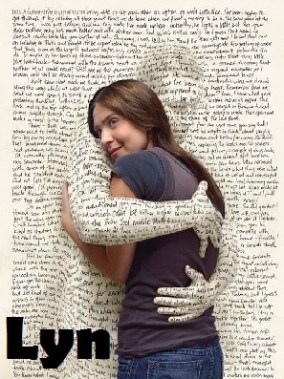
Poetry is:

huggingwordslyn

  • Poetry is truth in its Sunday clothes. ― Joseph Roux
  •   Poetry is just the evidence of life. If your life is burning well, poetry is just the ash. ― Leonard Cohen
  • Poetry is language at its most distilled and most powerful. – Rita Dove
  • Poetry is an act of peace. – Pablo Neruda
  • Genuine poetry can communicate before it is understood. – T.S. Eliot
  • To be a poet is a condition, not a profession. – Robert Frost
  • Poetry is nearer to vital truth than history. – Leonardo da Vinci
  • A poet is, before anything else, a person who is passionately in love with language. ― W.H. Auden
  • The courage of the poet is to keep ajar the door that leads into madness. ― Christopher Morley

#MyFirstPostRevisited

Creating a system for my Poetry practice

Writing the Life Poetic by Sage Cohen.

isbn 978-I-58297-557 Publication date 2009

Poetry is a passion of mine, I love reading and writing poetry. I discovered this book and have devoured the suggestions to broaden my horizons, my skills, and my reading enjoyment.

One of the suggestions, Ms. Cohen recommends works for me. Create yourself a place to come to when you work. I found it very helpful and decided to pass on the suggestions with you.  The categories are flexible, it’s up to you but I found these really met my needs. My ability to focus and accomplishing daily goals surprised me with her suggestions.

Great Quotes that motivate me about writing and life

Poems and Authors I Love offer inspiration and reassurance that my words matter.

Poems I am working on, my ideas, my acorns, whether in rough or editor process.

Finished work, it is hard to let people read your intimate thoughts.

Contests and deadlines, so I don’t miss opportunities.

Submission log, someday this will have lots of places.

Published Poems, I dare to dream!

My friends work matter a lot to me. We support each other with reviews and commentary.

  • Cut and paste your old post into a new post or reblog your own bad self. (Either way is fine but NO editing.)
  • Put the hashtag #MyFirstPostRevisited in your title.
  • Notify your tags in the comment section of their blog (don’t just hope they notice a pingback somewhere in their spam).
  • Feel free to cut and paste the badge to use in your post.
  • Include “the rules” in your post.

Editors and the 3 second rule

So many editors out there don’t or won’t invest more than 3 seconds maybe if we’re lucky  5 seconds to read our work. It’s true! Sad, but true. Publishers and editors have so many books crossing their desk or inbox they don’t have the time to invest more than that.

So how do you get them to read our work?

You have to write the best opening line possible? Write it and rewrite it again until everyone that you’ve shared your work says wow. Don’t be afraid to seek lots of opinions before you submit because getting the truth from family and friends is a lot easier to take than that rejection letter or worse the silent treatment.

Here are some great opening lines, you’re probably familiar with already.

“It was a bright cold day in April, and the clocks were striking thirteen.”
George Orwell, 1984

“It was the best of times, it was the worst of times.”
Charles Dickens, A Tale of Two Cities

“In a hole in the ground there lived a hobbit.”
J.R.R. Tolkien, The Hobbit

“It was a pleasure to burn.”
Ray Bradbury, Fahrenheit 451

So how do we create lines like this I suggest you check out this Hooked by Les Edgerton. He provides a concise informative read to help us create great openers too!

“The road to rejection is paved with bad beginnings. Agents and editors agree: Improper story beginnings are the single biggest barrier to publication. Why? If a novel or short story has a bad beginning, then no one will keep reading. It’s just that simple.”~ Amazon


Author Connections 6

Loneliness in a world filled with opportunity should be a paradox. Yet, we all experience that feeling at some point in our lives. We don’t want to do the same things, see the same people we want to change. We need change. But when that door is open, and we’ve ventured into another space and realize we have no connections, no kind face to make a connection with we feel isolated. Loneliness rears its ugly head.
I know there are other types of loneliness, but for today I am just addressing it as an author.Here on WordPress, we are blessed with the daily interaction we have. I’ve never forgotten how I initially felt here when I knew no one. I was alone, I felt lonely. My writing wasn’t read nor did I really know what direction to go. I only knew I was surrounded by people who loved what I love… WRITING. Over time by putting myself out there, I interacted with people, and a following began. We’re connecting.

However, in the real world where I exist that is not the case. Vic enjoys poetry but not to the extent I do. I find myself feeling alone because when we gather with other people, the conversations go from sports, politics, weather, movies anything but poetry which saddens me. I am reminded of Issac Asimov’s quote “Writing is a lonely job. Even if a writer socializes regularly, when he gets down to the real business of his life, it is he and his typewriter or word processor. No one else is or can be involved in the matter.”

My poem for today is about a writer’s need to name things. For Lisel Mueller, a German immigrant, fleeing Nazi Germany the English language was relatively new she chose to use very easy to understand the language a lot like her idol Carl Sandberg did to express herself in poetry. I believe she is still alive, I didn’t see any note otherwise https://www.poetryfoundation.org/poems-and-poets/poets/detail/lisel-mueller.

Things

By Lisel Mueller
What happened is, we grew lonely
living among the things,
so we gave the clock a face,
the chair a back,
the table four stout legs
which will never suffer fatigue.

We fitted our shoes with tongues
as smooth as our own
and hung tongues inside bells
so we could listen
to their emotional language,

and because we loved graceful profiles
the pitcher received a lip,
the bottle a long, slender neck.

Even what was beyond us
was recast in our image;
we gave the country a heart,
the storm an eye,
the cave a mouth
so we could pass into safety.

Lisel Mueller, “Things” from Alive Together: New and Selected Poems. Copyright © 1996 by Lisel Mueller. Reprinted by permission of Louisiana State University Press.

I find myself wanting to name things that surround me like my desk is my sanctuary whereas my garden once was. Now, my garden is my Zen space where I only rejuvenate. As we live, everything is named or has been appointed. We need the labels for they connect us. And we remember that we are not alone. It is up to us to change our perspective.

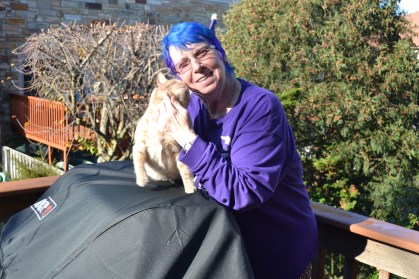
Just Lyn


DSC_0443 A spunky girl

No one really understood

All the carry-on ordeal

Where she once lived

Being her was a full-time job

but now

Meet the new powerful monarch

her wings are

radiant

and

her hair

is blue.